IP Insights
Who Owns What In A Film? A Guide To Rights In Indian Cinema
Estimated : 4 Mins
This blog breaks it down in the simplest way possible — no jargon, just clarity.
Why Rights Matter
Rights aren’t just legal formalities, they determine who can:
- Sell the film to a platform
- License songs or dialogues for ads
- Adapt the story into a web series
- Sue or be sued for infringement
If you don’t own it — you can’t exploit it.
Key Elements in a Film & Who Typically Owns Them
| Element | Typical Owner (unless otherwise agreed) |
|---|---|
| Script / Screenplay | Writer (can assign/often assigned to producer via contract) |
| Direction | Director (but rights often assigned to producer) |
| Cinematography / Footage | Cinematographer, unless assigned to producer |
| Music (Lyrics + Composition) | Lyricist + Composer; music label may later acquire rights |
| Performances (Actors) | Actor, unless performer’s rights are assigned |
| Background Score | Composer (often under a work-for-hire or assignment) |
| Edits / Cuts | Editor, but copyright lies with producer if done under contract |
| Final Film (Compilation) | Producer (only if all individual rights are assigned properly) |
Indian Copyright Law Basics
Under the Copyright Act, 1957:
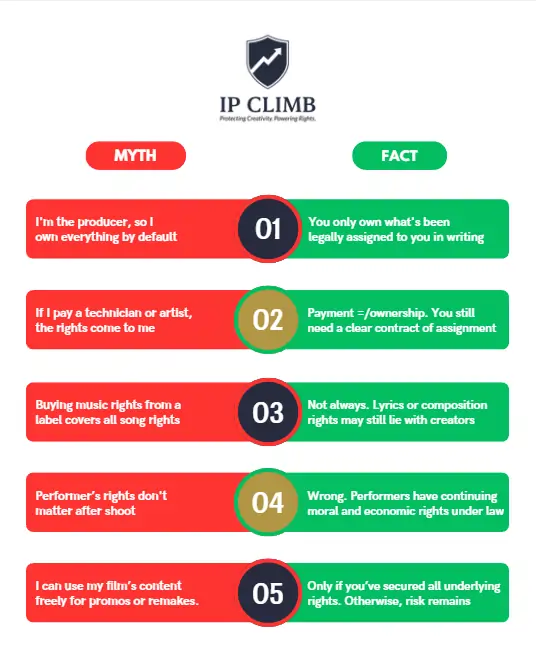
- Copyright initially vests with the creator, unless there’s a contract to the contrary.
- Section 17 governs authorship and ownership — the producer does not automatically own everything.
- Assignments and licenses must be in writing to be valid.
A signed agreement is not a formality — it’s the only way to secure rights legally.
What a Producer Must Do to Secure Ownership
To own the complete rights in a film, the producer should:
Sign Assignment Agreements
- With the writer, composer, lyricist, editor, etc.
- Clearly mention that “all rights, including copyright and performer’s rights, are assigned in perpetuity and worldwide.”
Include Performer’s Consent Clauses
- Particularly for actors and singers (performer’s rights are separate from copyright)
Obtain Music Licenses or Assignments
- Don’t rely on verbal deals — sync and master rights should be cleared
Secure Work-for-Hire Agreements (where applicable)
- Especially useful for technicians or junior contributors
Common Pitfalls & How to Avoid Them
| Mistake | Impact | Prevention |
|---|---|---|
| No written agreement with scriptwriter | Writer retains rights, producer cannot sell remake rights | Always execute a rights assignment agreement |
| Using existing song without license | Infringement; legal notice or takedown possible | Get synchronization rights before use |
| Assuming music label owns lyrics | Lyricist may sue even if label gave permission | Check chain of title for each element |
| Ignoring performer’s rights | Actors or singers can restrict future uses | Include performer’s release clause in contract |
Summary
Filmmaking is a collaboration — but rights must be consolidated to make the film marketable. In the absence of proper agreements, producers risk losing money, deals, and even ownership. Whether you’re a creator, producer, or platform — understanding who owns what in a film isn’t just legal housekeeping — it’s essential business hygiene.